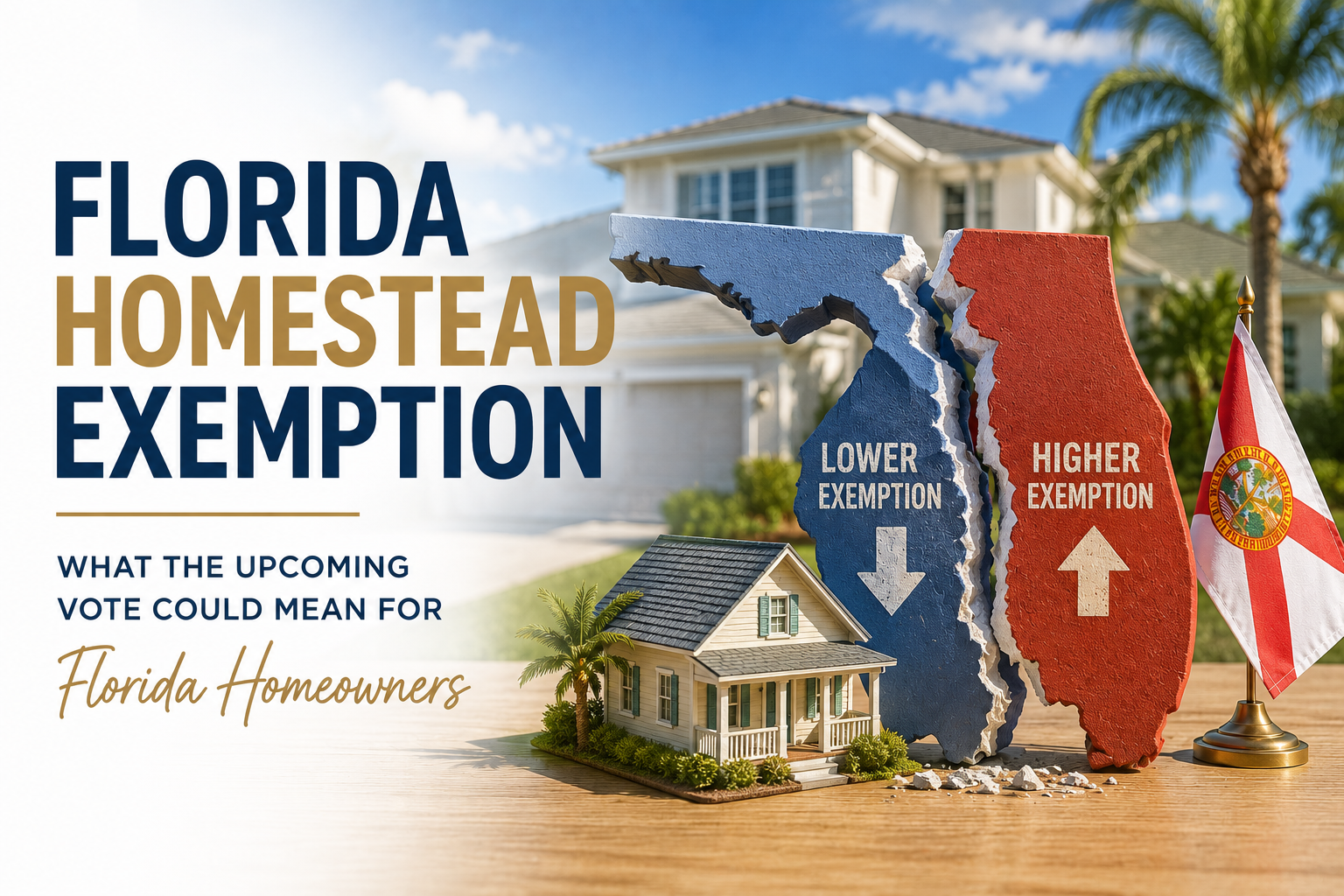
For most people relocating from the Northeast, finding the right home is only half the challenge. The other half is making sure the monthly budget still makes sense after closing. Florida's homestead exemption debate has been framed mostly as a political story, but for buyers planning a move, it's really a money story.
Here's what's currently in play. Florida's homestead exemption can reduce a qualifying primary residence's taxable value by up to $50,000, which directly lowers the property tax bill for eligible homeowners. A newer proposal being discussed for a 2026 ballot measure could expand that non-school tax relief significantly if approved by voters. That's a meaningful shift, and it's worth understanding before you sign anything.
The bigger question, though, isn't just how much you might save on taxes. It's where that savings could go across a full relocation budget. A lower tax bill doesn't exist in isolation. It connects to your mortgage escrow, your insurance planning, your moving costs, and how financially comfortable that first year of ownership actually feels. This article works through each of those connections in order, starting with the most immediate impact and moving into longer-term planning and the uncertainty that comes with any proposed policy change.
It Could Lower Your Monthly Housing Cost Sooner Than You Expect
When a homestead exemption reduces your property's taxable value, your lender recalculates the escrow portion of your monthly payment accordingly. That's not a year-end adjustment you wait around for. It shows up in what you actually owe each month, which matters most during that first stretch of ownership when cash flow feels the tightest.
This is especially relevant for buyers comparing Florida with higher-tax Northeastern states. Someone moving from New Jersey or Connecticut, where property taxes on a mid-range home can run well above $8,000 or $10,000 annually, may already be factoring in significant savings just by crossing state lines. The homestead exemption adds another layer on top of that.
To make it concrete, consider a home near Florida's 2025 statewide median single-family sale price of $413,990. Property tax rates vary by county, but even a modest reduction in taxable value through the current $50,000 exemption can translate to several hundred dollars less per year in taxes. If the proposed expansion moves forward, that number grows. Spread across 12 months, the monthly difference may not sound dramatic, but it's real money at a time when every line item counts.
What's worth keeping in mind is that property taxes are just one piece of total housing cost. Principal, interest, homeowners insurance, and HOA dues if applicable all factor into what a home actually costs to own each month. Viewing the homestead exemption as one part of that full picture, rather than a standalone benefit, gives you a more accurate read on affordability. A tax reduction that shaves $400 or $500 off your annual bill is genuinely useful, even if it doesn't transform your purchase price.
It May Free Up Cash for Insurance, Which Is Often the Bigger Shock
Florida's homeowners insurance market is one of the first things Northeast relocators tend to underestimate. The state's average homeowners premium, including wind coverage, has been cited around $3,825 per year, which is significantly higher than what most Northeastern buyers are used to paying. Add flood insurance if the property sits in a designated flood zone, and the total insurance cost can climb quickly.
This is where the homestead exemption debate becomes more than a tax conversation. Annual property tax savings, whether from the current exemption or a future expanded version, can function as a financial cushion that helps absorb those higher insurance costs. It's less about bonus money and more about balance. The savings from one line item help offset the pressure from another.
Connecting these two things matters because buyers who budget for their mortgage and taxes but overlook insurance often feel blindsided in that first year. A home that looked affordable on paper starts to feel stretched once the insurance bill arrives. Knowing that your property tax burden may be lower than what you paid up north, and potentially even lower if the proposed changes pass, gives you a more honest starting point for what Florida homeownership will actually cost.
Wind mitigation credits are also worth factoring in here. Florida law allows for insurance discounts when a home has certain storm-resistant features like hurricane straps, impact windows, or a reinforced roof. Pairing those discounts with a lower property tax bill creates a compounding effect on your monthly housing costs that can make a meaningful difference over the course of a year.
The broader point is that the homestead exemption debate is worth paying attention to even if property taxes aren't the largest expense you're worried about. When you're managing several large costs at once, any reduction in one area creates flexibility across the rest of your budget.
Your Move Date Could Matter Almost As Much As Your Home Price
Timing is one of the more practical and underappreciated parts of this debate. If the 2026 ballot proposal moves forward and passes, it would create a potential difference between buyers who establish permanent Florida residency before the end of 2026 and those who do so starting January 1, 2027. Two households buying nearly identical homes could end up with different early-year tax treatment based largely on when they made the move official.
For Northeast buyers who are still deciding whether to relocate now, wait another year, or spend a season in Florida before committing, that timeline deserves real consideration. This isn't about rushing a decision. It's about treating relocation timing as a financial planning question rather than purely a lifestyle one.
There are a few things worth mapping out as you think through your move date:
- When you establish Florida as your permanent residence determines your homestead eligibility window, and missing a filing deadline with your county property appraiser can push your benefits back by a full year.
- Buyers who close on a home but maintain a primary residence elsewhere won't qualify for homestead benefits until they make Florida their legal domicile, which involves more than just moving boxes.
- If the proposed expansion passes, locking in residency before any cutoff date could mean the difference between qualifying under new rules or waiting for the next cycle.
Relocation decisions involve enough moving parts already. Factoring the tax calendar into that planning doesn't make things more complicated. It actually gives you one more concrete reason to set a target date and work backward from it.
The Savings Could Help Cover All the Small Costs That Add Stress to a Move
Property tax savings rarely arrive as a lump sum you can spend directly. They show up gradually, built into a lower escrow payment or reflected in your annual tax bill. But over the course of a full year, that accumulated difference adds up to real money, and it's worth thinking about where that money could go during the most financially demanding stretch of a move.
The startup costs of relocating are easy to underestimate. Moving trucks, temporary housing if there's a gap between your closing and your move-in date, utility deposits, furniture for rooms that didn't need furnishing before, window treatments, storm prep supplies like shutters or a generator, and minor repairs or updates to a new home all land at roughly the same time. None of these are extravagant purchases. They're just the practical reality of setting up a new home, and they tend to arrive faster than your budget expects.
This is where modest tax savings can carry more weight than the dollar amount suggests. Many buyers don't need a tax break to change their purchase price. They need help with startup cash after closing, when the big expenses of the move are still fresh and the income side of the budget hasn't had time to stabilize. A few hundred dollars in annual tax savings, redirected toward those early costs, can reduce the feeling of being financially stretched during that adjustment period.
Treating the homestead exemption as part of your transition plan, rather than something separate from the logistics of moving, gives you a more complete picture of what Florida homeownership looks like in year one. The tax benefit doesn't need to be transformative to be genuinely helpful. It just needs to show up at the right time, and for most buyers, the first year is exactly that time.
The Long-Term Value May Be Bigger Than the First-Year Tax Break
The homestead exemption gets most of the attention, but the longer-term financial benefit for Florida homeowners actually comes from what happens after the first year. Florida's Save Our Homes assessment cap limits how much a homesteaded property's taxable value can increase annually, capping it at 3% or the rate of inflation, whichever is lower. For buyers planning to stay in a property for five, ten, or twenty years, that cap can be worth significantly more than the initial exemption itself.
Here's why that matters practically. In a market where home values are rising, a non-homesteaded property's taxable value can increase at whatever rate the market dictates. A homesteaded property is protected from those sharp jumps. Over time, the gap between assessed value and market value can grow substantially, which means your tax bill stays more predictable even as your home appreciates.
Portability is another benefit worth understanding, particularly for buyers who already own property in Florida and are considering a move within the state. Florida law allows homeowners to transfer accumulated Save Our Homes benefits from one homesteaded property to another, subject to eligibility requirements and filing deadlines. This doesn't apply to buyers moving from out of state, but it's relevant for anyone already in the Florida market who's thinking about upgrading or downsizing.
For Northeast buyers specifically, the combination of the exemption, the assessment cap, and potential portability down the road represents a more stable ownership environment than many are used to. States like New York and New Jersey reassess properties frequently and often aggressively, which means tax bills can climb sharply even when a homeowner's financial situation hasn't changed. Florida's structure rewards long-term ownership in a way that makes it worth planning around, especially for buyers who want predictability in retirement or remote-work living.
The Smartest Budget Assumes Today's Rules and Treats Future Tax Cuts as a Bonus
Proposed changes to Florida's homestead exemption are still subject to voter approval, and broader property tax reform ideas in the state have shifted over time. Building a relocation budget around a tax benefit that hasn't passed yet is a real planning risk, and it's one that's easy to fall into when the proposal sounds promising.
The more grounded approach is to run your numbers under current law first. Florida's existing $50,000 homestead exemption is real and available to qualifying primary residents right now. That's a solid foundation. Any future expansion, if it passes, becomes upside rather than a baseline assumption.
A few practical steps can help you plan accurately without leaving money on the table:
- Use your county's property tax estimator to calculate what you'd owe under current exemption rules for any home you're seriously considering. Most Florida county property appraiser websites have this tool available online.
- Confirm homestead eligibility requirements with your local property appraiser's office before closing, since the rules around permanent residency and filing deadlines vary slightly by county.
- Compare homeowners insurance quotes early, ideally before you make an offer, so that cost is already built into your budget rather than discovered after closing.
- Review the homestead application deadline for your county, since missing it means waiting another full year to receive the benefit.
Running a second scenario that models potential savings under the proposed expanded exemption is also worthwhile, as long as it's clearly labeled as a best-case possibility rather than a guarantee. That way, if the proposal passes, you'll already know exactly what it means for your budget. And if it doesn't, your plan still holds up.
Conclusion
The homestead exemption debate touches more of a relocation budget than most buyers initially realize. It connects to monthly affordability, insurance planning, moving costs, and the long-term stability of owning a home in Florida. None of those connections require the proposal to pass in order to matter. Understanding them helps you make smarter decisions with the rules that already exist.
Predicting every policy outcome before making a move isn't realistic, and it's not necessary. What is realistic is building a budget grounded in current law, staying informed about what's being proposed, and knowing that any future tax relief would only improve a plan that already makes financial sense. That's a position worth being in, and getting clear on these details is what makes a Florida move feel less like a leap and more like a well-considered step forward.
Check out this article next